By Sakshi Makkar | Founder, HavStrategy
Author bio : Sakshi has spent 6+ years building and scaling D2C brands across beauty, fashion, and lifestyle — working directly with 200+ founders across India, USA, UK, UAE, and Australia. She has generated $15M+ in ecommerce revenue and delivered 8.5X ROAS on Meta for beauty and fashion brands with her team. She writes from direct experience with brand-building problems, not industry theory.
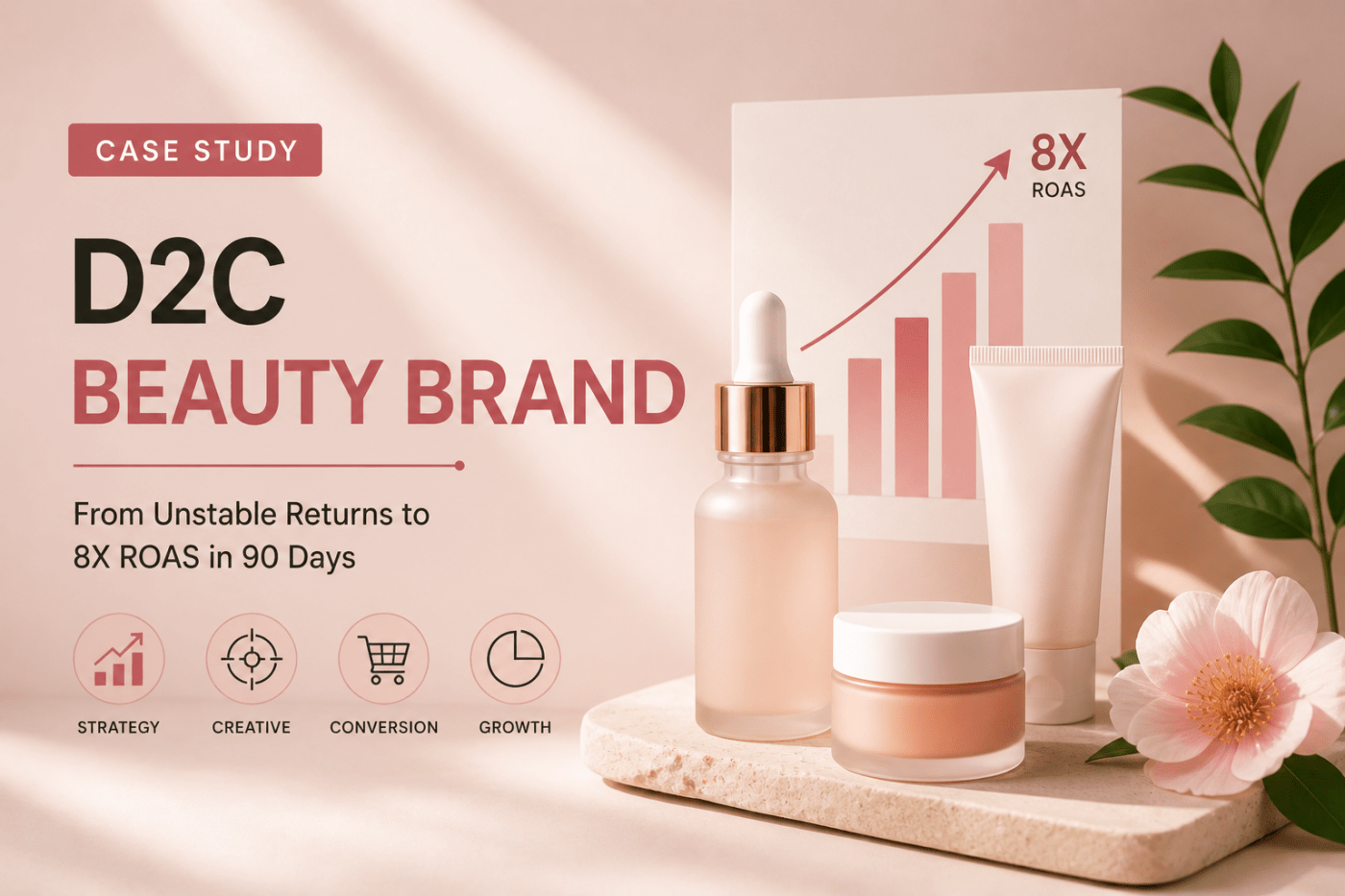
A D2C beauty brand does not need a massive ad budget to scale. It needs the right diagnosis. In this D2C beauty brand case study, I am breaking down how we helped a beauty brand go from spending ₹2L/month with inconsistent returns to achieving 8X ROAS in 90 days. This was not done through one viral Reel, one lucky Meta campaign, or one discount-led offer. It happened because we rebuilt the brand’s performance system across ads, creatives, website conversion, and demand capture.
This case study is based on a real HavStrategy engagement. The brand name and certain commercial details are anonymized for confidentiality, but the strategy, funnel problems, and performance patterns are exactly what we see across the 150+ D2C brands we have worked with.
Table of Contents
- The starting point: a beauty brand spending ₹2L/month but stuck below profitable scale
- Why most D2C beauty brands fail to scale ROAS after early traction
- Our first 30 days: diagnosing the full beauty marketing funnel
- The performance marketing reset that changed the account structure
- The creative system behind the 8X ROAS jump
- How website CRO turned traffic into higher beauty product conversions
- How Google Ads supported Meta instead of competing with it
- The 90-day results: what actually moved ROAS from unstable to scalable
- What D2C beauty founders should learn from this case study
- Work with a D2C beauty marketing agency that understands profitable scale
The starting point: a beauty brand spending ₹2L/month but stuck below profitable scale
When this beauty brand came to HavStrategy, it was already spending around ₹2L per month on ads. That is an interesting stage for a D2C beauty business. The brand is not at zero. It has some product-market signal. There are purchases, add-to-carts, comments, DMs, and a few creatives that seem to work for a while. But the brand is also not stable enough to confidently scale to ₹5L, ₹10L, or ₹20L per month.
The founder’s main problem was not “ads are not working.” The problem was that ads were working unpredictably.
Some weeks looked strong. ROAS would spike. A few campaigns would show promising numbers. Then performance would drop without a clear reason. Cost per purchase increased. Add-to-cart rates fluctuated. Retargeting looked profitable, but prospecting did not bring enough qualified buyers. This is a common pattern we see in beauty brands spending between ₹1L and ₹5L per month.
The brand had a skincare-led product mix with a hero product, supporting products, and a few bundles. The AOV was healthy enough to support paid acquisition, but the funnel was not structured to protect profitability. The Meta account had too many fragmented campaigns for the available budget. Creatives were attractive, but they were more aesthetic than persuasive. The product page explained what the product was, but not why a first-time buyer should trust it.
At this stage, most founders assume the fix is more budget. In our experience, that often makes the problem louder. If a brand cannot hold performance at ₹2L/month, scaling spend usually exposes weak creative, unclear product education, poor landing page hierarchy, and audience overlap.
Our first goal was simple: stop treating this like an ads-only problem. We approached it as a full-funnel beauty growth problem.
Why most D2C beauty brands fail to scale ROAS after early traction
The most dangerous stage for a D2C beauty brand is not launch. It is the stage right after early traction. The founder has seen enough sales to believe the product works, but not enough consistency to understand what is driving those sales.
Across the beauty and skincare accounts we audit, the same pattern appears again and again. Early purchases often come from warm audiences, founder networks, influencer spillover, existing Instagram followers, or limited-time offers. These sales are real, but they can create false confidence. When the brand starts scaling cold traffic, the funnel behaves differently.
Beauty buyers need more trust than many other D2C categories. A customer buying a serum, sunscreen, moisturizer, foundation, lipstick, or haircare product is not just buying a look. They are asking: Will this suit my skin? Will it irritate me? Is the shade accurate? Is the texture comfortable? Is the brand credible? Are the reviews real? Will I regret trying this?
If the ad does not answer these questions, the website must. If the website does not answer them, the founder pays for doubt.
In this case, the brand’s ads were visually strong but not conversion-led. They showed the product beautifully, but they did not always communicate the reason to buy. The product page listed features, but it did not build enough belief. The retargeting campaign reminded people of the product, but it did not address the objections stopping them from purchasing.
This is why ROAS was unstable. The brand was not short of traffic. It was short of conviction.
A typical example: one of the brand’s best-performing creatives showed product texture and packaging. It brought low-cost clicks, but the purchase rate was weak. When we rebuilt the creative around a clearer use case — the skin concern, the product benefit, the texture experience, and the reason it was safe for daily use — the same product attracted fewer casual clicks but better buyers.
That shift matters. High CTR is not always good traffic. In beauty, curiosity clicks can burn budget fast. Purchase intent comes from relevance, clarity, and trust.
Our first 30 days: diagnosing the full beauty marketing funnel
The first 30 days were not about launching everything at once. They were about finding the leak.
At HavStrategy, our beauty and skincare marketing work starts with a simple belief: a beauty brand’s ROAS is rarely controlled by the ad account alone. The ad account shows the symptoms. The real issue may sit in creative strategy, PDP trust, offer structure, tracking, product education, or audience quality.
We audited the Meta Ads account first. The account had multiple campaigns running with limited budget distribution. Some ad sets were too small to exit learning properly. Some campaigns were competing with each other. Retargeting audiences were overlapping. Creative testing was happening, but there was no clear system for deciding what to kill, what to iterate, and what to scale.
Then we reviewed the website and product pages. The product visuals were good, but the decision-making flow was weak. The hero section did not immediately explain the transformation. Benefits were present, but not prioritized. Ingredients were listed, but not translated into customer outcomes. Reviews existed, but they were not placed where hesitation was highest.
We also looked at AOV and offer structure. The brand was pushing single-product purchases heavily, even though bundles made more sense for profitability. For beauty brands, this is a major difference. If a ₹699 product has to carry the full burden of acquisition, Meta becomes unforgiving. But if the brand can move a buyer into a ₹1,499 or ₹1,999 routine bundle, the same CAC becomes much easier to absorb.
By the end of the first 30 days, we had a clear diagnosis. The brand did not need more campaigns. It needed fewer, sharper campaigns. It did not need more creatives. It needed better creative angles. It did not need a heavier discount. It needed stronger product education and clearer conversion paths.
This is where the account started changing.
The performance marketing reset that changed the account structure
The first major change was campaign structure.
Many D2C beauty brands overcomplicate Meta Ads too early. They create separate campaigns for interests, lookalikes, broad audiences, retargeting, engagement audiences, product viewers, cart abandoners, and seasonal offers. That may sound strategic, but at ₹2L/month ad spend, it often creates a learning problem.
The budget gets divided into too many small pockets. Meta does not get enough clean conversion data. The founder sees five campaigns with partial signals instead of one clear picture of what is actually working.
We simplified the structure.
The new account architecture focused on cleaner prospecting, controlled retargeting, and structured creative testing. Instead of treating every audience as a separate strategy, we treated creative as the main targeting lever. This is especially important in beauty, where the same product can appeal to different customers depending on the angle. A moisturizer can be sold through dryness, barrier repair, makeup prep, sensitive skin comfort, or climate suitability. Each angle attracts a different buyer.
The performance marketing system was rebuilt around three priorities: stable learning, creative clarity, and profitable budget allocation.
We did not scale all winning ads immediately. That is another mistake founders make. A creative that works at ₹500/day may not survive at ₹5,000/day. So we used controlled scaling. If an ad showed strong purchase intent, we increased budget gradually and watched blended ROAS, CAC, add-to-cart rate, and checkout quality together.
The biggest shift was moving away from reactive optimization. Before HavStrategy, the account was being changed too frequently. A campaign would run for two days, results would fluctuate, and decisions would be made too quickly. We slowed the decision cycle where needed and sped it up where the signal was obvious.
By day 45, the account had fewer campaigns, cleaner reporting, stronger creative learning, and better budget discipline. That created the foundation for ROAS growth.
The creative system behind the 8X ROAS jump
The creative system did the heavy lifting.
In beauty marketing, creative is not decoration. It is the sales conversation before the product page. A good creative does not just look premium; it reduces hesitation. It shows the product in use. It makes the benefit believable. It tells the customer, “This is for your exact concern.”
For this brand, we divided creatives into clear conversion angles. One angle focused on the hero skin concern. Another showed texture and application. Another explained the formulation in simple language. Another used UGC-style proof. Another positioned the product as part of an everyday routine instead of a one-time trial.
This is what we consistently see across beauty brands doing ₹30L to ₹1Cr/month: the brands that scale are not making random content. They are building repeatable creative systems.
A skincare founder may love a premium flat-lay image. It looks beautiful on the feed. But a cold buyer may need to see how the serum spreads, how quickly it absorbs, whether it layers under sunscreen, whether it feels sticky, and what kind of skin it is designed for. The creative has to answer the buying question, not just represent the brand aesthetic.
We introduced founder-led and expert-led trust formats where appropriate. Not every beauty brand needs the founder on camera daily, but trust-led storytelling can significantly improve buyer confidence. We also tested native UGC that felt like a real customer explaining why she switched, what concern she had, and what she noticed after using the product consistently.
The strongest ads were not the loudest. They were the clearest.
A texture-led Reel outperformed a polished studio shot because it made the product feel real. A benefit-led testimonial outperformed a generic offer ad because it explained the use case. A routine bundle creative helped increase AOV because it showed the products working together instead of competing separately.
Around the halfway point, we also aligned creative testing with landing page improvements. If your beauty brand is struggling with unstable ROAS, HavStrategy’s Meta and Google performance marketing team can help diagnose whether the issue is traffic quality, creative fatigue, or funnel conversion.
By the end of the second month, creative was no longer being treated as “content for ads.” It had become the engine of customer acquisition.
How website CRO turned traffic into higher beauty product conversions
Once traffic quality improved, the next challenge was conversion.
A beauty brand’s product page has to do more than describe the product. It has to replace the experience of touching, testing, smelling, swatching, or asking a beauty advisor in-store. That is why CRO for beauty is so different from CRO for generic ecommerce.
For this brand, the product detail page was clean but under-persuasive. The above-the-fold section had product imagery, price, and add-to-cart, but the “why now” was weak. The page did not immediately communicate who the product was for, what concern it solved, and why it was different from similar products in the market.
We rebuilt the page hierarchy.
The first screen needed a sharper benefit statement. The product claims had to be specific without overpromising. Ingredient education had to be simplified. Reviews had to appear closer to the buying decision. Routine pairings had to be explained in a way that increased AOV without confusing the customer.
For example, instead of simply saying “contains niacinamide,” the page needed to explain what that meant for the customer’s visible concern. Instead of showing a bundle as a discount pack, it needed to be framed as a complete routine. Instead of hiding FAQs at the bottom, key objections had to be answered before the customer dropped off.
We also improved checkout flow and trust signals. In beauty, small trust markers matter: delivery clarity, return information, authenticity, skin suitability notes, usage instructions, and visible customer proof. A founder may think these are minor details. But when a cold user lands from an ad, these details decide whether the click becomes a purchase.
This is why we connected paid media with website development and CRO strategy. Ads can create demand, but the website has to convert that demand without forcing the customer to work too hard.
The CRO changes did not just improve conversion rate. They also made the ads more scalable. Once the page answered objections better, we could send more cold traffic without ROAS collapsing as quickly.
How Google Ads supported Meta instead of competing with it
One of the biggest mistakes D2C beauty brands make is treating Meta and Google like separate channels with separate goals. In reality, they should support each other.
Meta is excellent for creating demand. It introduces the product to people who may not be actively searching for it. Google is excellent for capturing demand once interest exists. If someone sees a skincare ad on Instagram, checks the brand, leaves, and later searches the brand name or product category, Google should be there to catch that intent.
Before we restructured the funnel, the brand’s Google Ads presence was underused. Branded search was not fully protected. High-intent product searches were not organized properly. The brand was relying too heavily on Meta to both create and close demand.
We introduced a sharper Google Ads strategy around demand capture. Branded search helped protect traffic from competitors and marketplaces. Product-led search campaigns targeted users already looking for similar beauty solutions. Retargeting supported users who had visited the website but had not purchased.
This did not mean Google suddenly became the main revenue channel. That was not the point. The point was to stop losing warm demand.
For a beauty brand spending ₹2L/month, even small leaks matter. If Meta is creating curiosity and Google is not capturing the follow-up search, the brand pays to educate the customer and then risks losing her elsewhere. This becomes even more costly when competitors bid on similar terms or when marketplaces dominate search results.
The combined effect was stronger blended ROAS. Meta brought discovery. Google captured intent. Website CRO converted the traffic. Retargeting reminded users with better proof.
That is how the system started compounding.
The 90-day results: what actually moved ROAS from unstable to scalable
By the end of 90 days, the brand had moved from inconsistent performance at around ₹2L/month ad spend to 8X ROAS.
The result was not created by one campaign. It came from several connected improvements.
The account structure became cleaner. Campaign learning improved because the budget was no longer split across too many weak ad sets. Creative testing became more disciplined. Instead of randomly trying new visuals, we tested specific buying angles: concern, ingredient, texture, routine, proof, and offer.
The website converted better because it answered objections earlier. The product pages made the benefit clearer. Bundles improved AOV. Trust blocks reduced hesitation. FAQs helped users understand usage, suitability, and routine fit.
Google Ads improved demand capture. People who searched after seeing Meta ads had a clearer path back to the brand. Retargeting became more useful because it was supported by stronger creative and website education.
The most important metric was not just ROAS. It was stability.
Founders often celebrate a one-day ROAS spike. We do not. A single-day 12X ROAS can happen because of delayed attribution, a warm audience pocket, or a few high-value purchases. What matters is whether the brand can hold stronger returns over time while increasing spend responsibly.
In this case, 8X ROAS mattered because it came with better funnel clarity. We knew which creative angles worked. We knew which products acquired customers efficiently. We knew which bundles protected profitability. We knew where the next scaling opportunity would come from.
That is the difference between a lucky campaign and a growth system.
What D2C beauty founders should learn from this case study
The biggest lesson from this D2C beauty brand case study is simple: do not scale confusion.
If your Meta account is messy at ₹2L/month, it will become more expensive at ₹10L/month. If your creative is unclear, more impressions will not fix the message. If your product page does not build trust, better traffic will still leak. If your AOV is too low, even a decent CAC can feel unprofitable.
What we see consistently across D2C beauty brands is that founders often try to solve the wrong problem first. They change targeting when the creative is weak. They increase discounts when the product education is unclear. They hire influencers when the website cannot convert. They launch new products when the hero product still does not have a strong acquisition system.
The brands that scale profitably think differently.
They treat creative as research. Every ad reveals what the customer cares about. They treat the website as a sales assistant. Every product page must answer objections before they become exits. They treat paid media as a system. Meta, Google, influencer content, CRO, and retention should not operate in silos.
For beauty specifically, trust is the multiplier. A customer may like the packaging, but she buys when the concern, benefit, proof, and experience make sense together.
If you are spending ₹1L to ₹5L/month and your ROAS keeps fluctuating, the answer is probably not “run more ads.” The answer is to find the part of the funnel that is weakening buyer confidence.
That is where profitable scale begins.
Work with a D2C beauty marketing agency that understands profitable scale {#work-with-havstrategy}
HavStrategy works with beauty, skincare, fashion, lifestyle, luxury, and home decor brands that want performance marketing built around profit, not vanity metrics.
If your brand is already spending on Meta or Google but struggling with unstable ROAS, unclear CAC, weak creative testing, or poor website conversion, we can help you diagnose the full funnel and build a more scalable growth system.
Explore HavStrategy’s D2C beauty marketing agency services or book a discovery call to discuss where your funnel is leaking and what it would take to scale profitably.
Sakshi Makkar | Founder, HavStrategy
Sakshi has spent 6+ years building and scaling D2C brands across beauty, fashion, and lifestyle — working directly with 200+ founders across India, USA, UK, UAE, and Australia. She has generated $15M+ in ecommerce revenue and delivered 8.5X ROAS on Meta for beauty and fashion brands with her team. She writes from direct experience with brand-building problems, not industry theory.


Leave a comment